 Servflow
 Kofo Okesola
I set up a Make scenario that watched a webhook, looked each record up in a sheet, and posted a summary to Slack. Four modules, a few credits a run. It ran for a week without a thought. Then a batch import fired the webhook once per row, the iterator ran every module after it for each record, and the month's 10,000 credits were gone before lunch.
Nothing was broken. That is how Make counts. This page explains the unit, the plans, a small team's month, and where a loop empties it.
Credits and operations
Since 27 August 2026, credits are the billing unit on Make. The thing that spends them is the operation.
- An operation is one module run on one bundle. It uses one credit.
- A bundle is one item of data moving through the scenario: one email, one row, one webhook payload.
- A scenario run uses as many credits as it has module runs. Four modules on one bundle is four credits. Four modules on ten bundles is forty.
The AI modules, OpenAI and the others, count the same way: one operation each on Make's side. The model provider then bills the tokens separately, on its own invoice.
The plans
Prices read on make.com/pricing on 2 November 2026, at the 10,000 credits a month setting.
| Plan | Monthly billing | Billed annually | Per 1,000 credits |
|---|---|---|---|
| Free | $0, 1,000 credits a month | ||
| Core | $10.59 a month | $9 a month | $1.06 monthly, $0.90 annually |
| Pro | $18.82 a month | $16 a month | |
| Teams | $34.12 a month | $29 a month |
Over the limit, Make's page puts it plainly: "Your scenarios won't continue to run, until credits are added again." Extra credits come in bundles of 1,000 or 10,000 at the price fixed by your plan, and Core, Pro and Teams can turn on auto-purchase of 10,000 at a time.
A five-person team's month
The same three automations I used on what an AI automation costs per run, counted in Make operations. The module counts are my own estimates of how I would build each scenario.
| Automation | Modules in one run | Operations per run | Runs a month | Operations a month |
|---|---|---|---|---|
| Inbox triage | Gmail watch, AI module, create draft, message | 4 | 300 | 1,200 |
| Daily report to Slack | Schedule trigger, lookup, AI module, Slack | 4 | 22 | 88, about 90 |
| Meeting prep brief | Calendar, Gmail search, Notion, AI module, message | 5 | 60 | 300 |
| Month | 382 | about 1,600 to 1,700 |
The range is for meeting prep. If the scenario iterates over attendees to search Gmail for each one, a meeting with six people adds rows, and the month drifts up.
About 1,700 credits sits well inside Core's 10,000 at $10.59 a month. Add the AI bill from OpenAI or whoever runs the model, which Make does not show you.
Where a loop multiplies
The math above assumes one bundle per run.
An iterator. An iterator splits one bundle into many, and every module after it runs once per item. An iterator over 50 records runs every module after it 50 times. An iterator over a 500-row sheet with three modules after it is 1,500 operations in one run. That is 15 percent of Core's month from a single run.
A webhook storm. A webhook trigger runs the scenario once per call. A batch import that fires the webhook 2,000 times, through a four-module scenario, is 8,000 operations in an afternoon. That was my morning.
Errors. Make's pricing page lists what does not use credits: the error handler modules (Rollback, Break, Resume, Commit, Ignore) and the router. It says nothing about modules that ran and failed. The help pages on credits and operations are silent too. So plan for a module that ran and failed to count.
None of this is secret. The scenario editor just does not show what a run will cost before it runs, and the execution log shows modules and bundles, not one number.
Who should stay on Make
Stay if your scenarios move data and do not think, and run under 10,000 operations a month. At $9 to $10.59 a month, Make's Core plan is the cheapest tool for that work, and nothing on this page changes that. Stay if you have scenarios with careful error handling already built, filters before the iterators and a sensible cap on what a webhook accepts. Rebuilding that elsewhere costs time for little gain.
Look elsewhere if your scenarios have AI modules in them and you cannot predict what they cost, or if you have already had the day the credits ran out.
The same month on Servflow
Servflow counts differently. Each automation runs as one agent, from $10 a month with AI at cost. Credits pay for the AI at what it costs us, plus 4 credits a run, and 1 credit is $0.001.
A loop inside a Servflow run is still one run: 4 credits plus the AI, whether it handles one record or 500. Use your own key and pay only the 4-credit run fee.
| Automation | Runs a month | Credits per run, small model | Mid model | Large model |
|---|---|---|---|---|
| Inbox triage | 300 | 6 | 15 | 36 |
| Daily report to Slack | 22 | 9 | 33 | 92 |
| Meeting prep brief | 60 | 6 | 18 | 46 |
| Month in credits | 382 | 2,358 | 6,306 | 15,584 |
That is the $10 plan for 10,000 credits on a small or mid model, and the $25 plan for 26,000 on a large one, with the AI included. The $50 plan holds 55,000. Free is 4,000 credits once, no card. Credits stop at zero. Nothing is billed past your plan unless you top up, at $1 per 1,000 credits.
To be plain about it: for data moving with no AI in it, Make's Core plan is cheaper. What Servflow adds is the AI on the same number, the cost shown on every run, and a cap that holds.
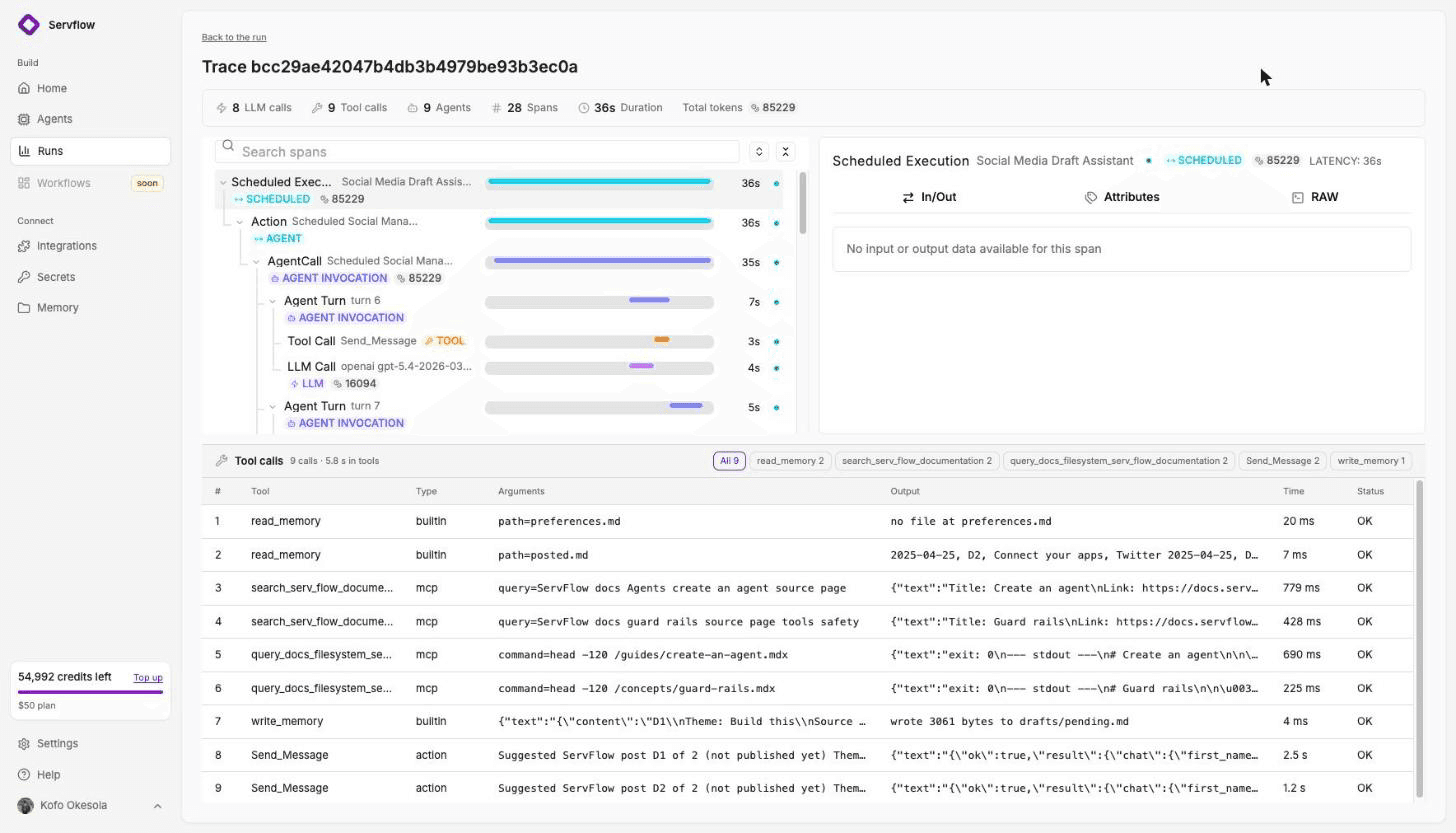
How this runs on Servflow
Every run on Servflow is a trace: the trigger at the top, each step under it, each model call with its token count, and the credits the run used. The runs list has a Credits column, and the month's bill is the sum of that column. If one run costs more than the last, the trace says which step did it.
FAQ
What is an operation on Make? One module run on one bundle. Each operation uses one credit, and since 27 August 2026 credits are Make's billing unit. A scenario with four modules that runs once on one bundle uses four credits.
How much does Make cost a month? At the 10,000 credits a month setting: Core is $10.59 a month, or $9 billed annually. Pro is $18.82, or $16 annually. Teams is $34.12, or $29 annually. Free is 1,000 credits a month.
Why did one Make scenario use so many credits? Usually a loop. An iterator over 50 records runs every module after it 50 times, and a webhook that fires once per row of a batch import does the same. Each module run on each bundle is a credit.
Do failed operations count on Make? Make's pricing page lists error handler modules (Rollback, Break, Resume, Commit, Ignore) and the router as not using credits. It says nothing about modules that ran and failed, and the help pages are silent too, so plan for them to count.
What happens when Make runs out of credits? Your scenarios stop until credits are added. Extra credits come in bundles of 1,000 or 10,000 at the price your plan sets, and Core, Pro and Teams can buy 10,000 automatically.
Start free
4,000 credits, no card, and every run shows what it cost. From $10 a month, AI at cost.
Related: Pricing · What an AI automation costs per run · Make alternatives · Zapier pricing for a small team · n8n Cloud pricing explained