 Servflow
 Kofo Okesola
I went looking for a straight answer to "what does an AI automation cost per run" and did not find one. Zapier prices a task. Make prices an operation. n8n prices an execution. All three leave the AI itself on a separate bill from OpenAI or Anthropic, so the one number you want, what this run cost, is split across two invoices and never shown.
This page works it out. The numbers for Servflow come from its billing code. The model prices are illustrative tiers, because the real ones change monthly, and I say so where I use them.
Two things make up a run
A run is one execution of an automation from trigger to answer: the email arrived, the automation read it, decided, drafted, messaged you. Two costs go into it.
- The AI. A model reads tokens and writes tokens. A token is a piece of text about three quarters of a word long. Models are priced per million tokens, with a lower rate for what they read (input) and a higher one for what they write (output). An email with the automation's instructions is about 6,000 input tokens. A short draft reply is about 800 output tokens.
- The run itself. The tool's charge for the trigger, the steps, the retries, the trace. Zapier calls it a task, Make an operation, n8n an execution, Servflow a run fee.
On Servflow the two are added on one run and shown as one number. Credits pay for the AI at what it costs us, plus 4 credits a run. 1 credit is $0.001.
The model tiers I use below
Model prices move, so I use three illustrative tiers rather than name a model and be wrong by December. Servflow's dashboard shows the live rate for each model when you pick it.
| Tier | Price per million tokens | Credits per million tokens on Servflow |
|---|---|---|
| Small | $0.15 in, $0.60 out | 158 in, 633 out |
| Mid | $1 in, $5 out | 1,055 in, 5,275 out |
| Large | $3 in, $15 out | 3,165 in, 15,825 out |
The credit figure is the dollar price times 1.055, the 5.5 percent routing fee Servflow pays on each call, at $0.001 a credit. There is no markup of Servflow's on top of that. Each model call is rounded up to the next whole credit.
One run of inbox triage
The automation reads one new email, decides whether it needs a reply, saves a draft in Gmail and messages you on Discord if it is urgent. One model call: 6,000 tokens in, 800 out.
| Tier | Input | Output | AI cost in credits | Run fee | Total |
|---|---|---|---|---|---|
| Small | $0.0009 | $0.00048 | 2 | 4 | 6 |
| Mid | $0.006 | $0.004 | 11 | 4 | 15 |
| Large | $0.018 | $0.012 | 32 | 4 | 36 |
So one email triaged costs between six tenths of a cent and 3.6 cents, and most of the difference is the model you picked.
A five-person team's month
Three automations a small team sets up first, with the token sizes I measured on my own runs, rounded.
| Automation | Runs a month | Tokens per run | Small | Mid | Large |
|---|---|---|---|---|---|
| Inbox triage | 300 | 6,000 in, 800 out | 6 | 15 | 36 |
| Daily report to Slack | 22 | 20,000 in, 1,500 out | 9 | 33 | 92 |
| Meeting prep brief | 60 | 10,000 in, 600 out | 6 | 18 | 46 |
| Month in credits | 2,358 | 6,306 | 15,584 | ||
| Plan that covers it | $10 | $10 | $25 |
The small and mid tiers fit in the $10 plan with room left. The large tier needs the $25 Starter plan. Credits stop at zero, so if the month runs long the automations stop rather than bill you past the plan.
The same month on the other tools
The comparison is not like for like, because the other three bill the AI separately.
| Servflow | Zapier | Make | n8n Cloud | |
|---|---|---|---|---|
| Unit | A run: 4 credits plus the AI at cost | A task per successful action step; AI steps 1x, 3x or 5x tasks | A credit per module operation | An execution per run |
| The 382 runs above | 2,358 to 15,584 credits, AI included | About 1,970 tasks | About 1,670 credits | 382 executions |
| Plan that covers the runs | $10 or $25 | More than the 750-task Professional plan at $29.99 | Core at $10.59 ($9 billed annually) | Starter at €20 a month billed annually ($24 monthly) |
| The AI bill | In the credits | Separate, from your provider, unless you use AI by Zapier at 3 tasks a step | Separate, from your provider | Separate, from your provider |
| Cost of one run shown | Yes, on every run | No | No | No |
Make is the cheapest plan here for plain data moving, and this page is not going to pretend otherwise. What Servflow does differently is put the AI and the run on one number, cap it at your plan, and show it on each run. Zapier's bill, Make's and n8n's each get their own page.
What makes a run expensive
My own traces show three things that make a run expensive. The first matters most.
- Input size. A thread with twenty replies is ten times the tokens of a new email. Automations that read whole documents or long histories cost more per run than ones that read one message.
- The model. The large tier is six times the mid tier and twenty times the small one. Most triage and drafting jobs read fine on the mid tier.
- Tool calls. Each tool the automation calls means another model call to decide what to do with the result. A run that searches, reads and then drafts is three calls, each rounded up.
The run fee is the one part that never moves. Four credits, however many steps.
How this runs on Servflow
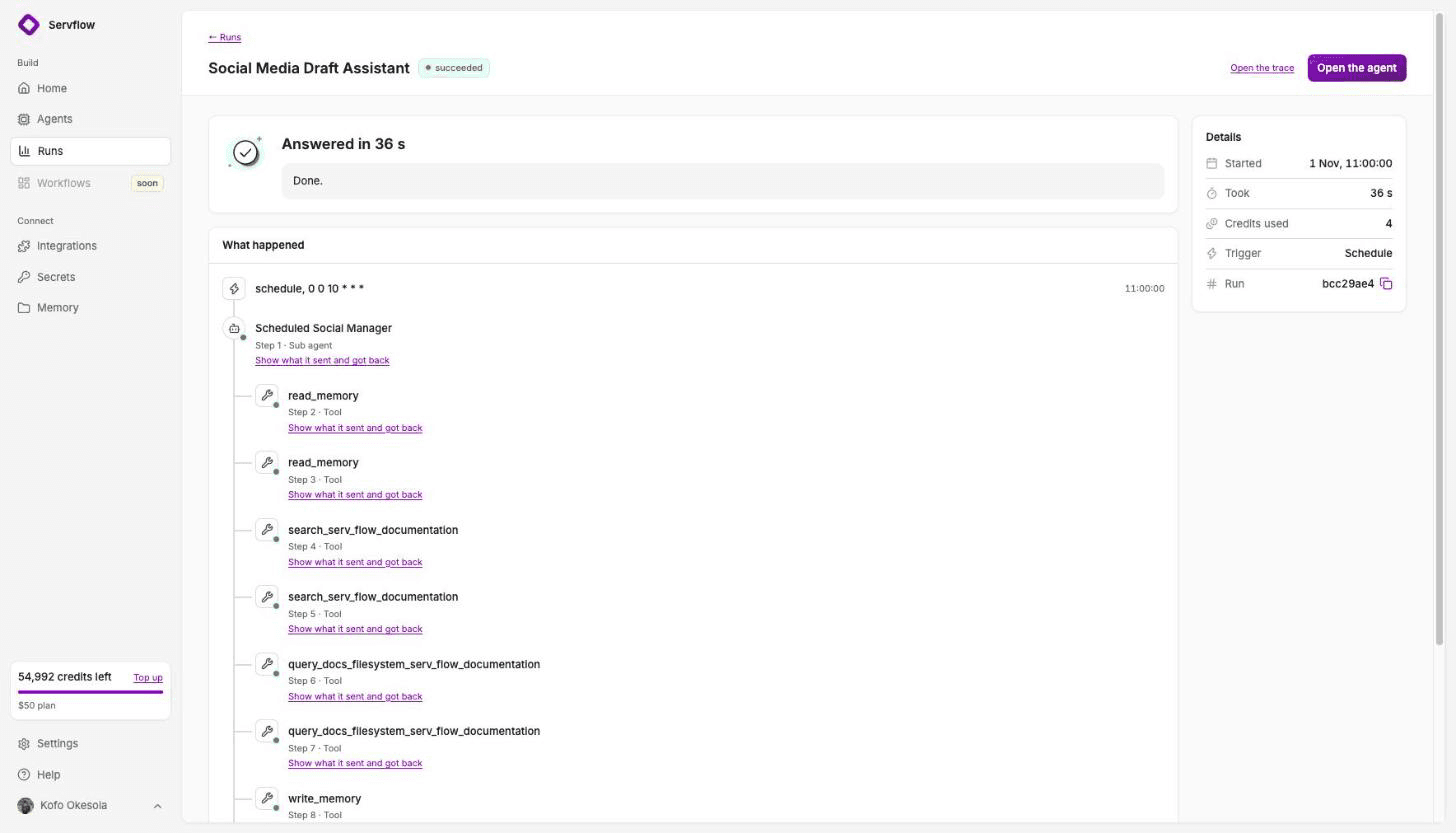
Every run on Servflow is a trace: the trigger, each step, each model call with its token count, and the credits it used. The runs list has a Credits column, and the bill for the month is the sum of that column. If one run costs more than the last, the trace says which step did it.
If you would rather pay your provider directly, add your own key. Servflow then charges only the 4-credit run fee and the provider bills the tokens.
FAQ
How much does an AI agent cost per run? The model's price for the tokens the run used, plus the tool's charge for running it. On Servflow a run is 4 credits plus the AI at cost, about 6 credits for inbox triage on a small model and 36 on a large one, with 1 credit worth $0.001. Other tools bill a task, an operation or an execution and leave the AI on a separate bill.
What is a token? A piece of text about three quarters of a word long. Models are priced per million tokens, with separate rates for what they read (input) and what they write (output). A typical email with its instructions is about 6,000 input tokens; a short reply is about 800 output tokens.
Why do AI automation costs vary between runs? Because the model decides how much to read and write. A long email thread is more input; a run that calls three tools makes three model calls. The run fee is fixed, the AI part moves with the work, and that is why a per-run number matters more than a plan price.
Is it cheaper to bring my own API key? On Servflow you then pay only the 4-credit run fee, and the provider bills you for the tokens at their list price. The total is about the same; the difference is who sends the bill. Built-in models cost the model's price per token plus a 5.5 percent routing fee.
How many credits does a small team need a month? For three automations, inbox triage on 300 emails, a daily report and prep for 60 meetings, about 2,400 credits on a small model, 6,300 on a mid one and 15,600 on a large one. That is the $10 plan for the first two and the $25 plan for the third.
Start free
4,000 credits, no card, and every run shows what it cost. From $10 a month, AI at cost.
Related: Pricing · Zapier pricing for a small team · Make pricing: what an operation is · n8n Cloud pricing explained · Zapier alternatives for small teams